
Featured Article
Implementation
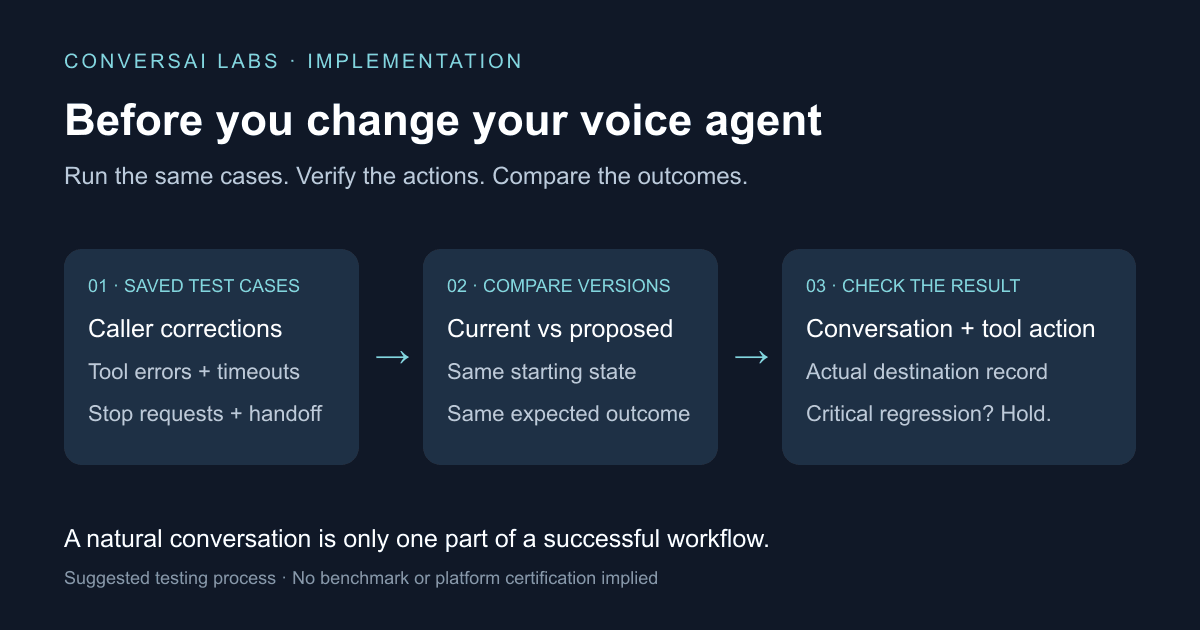
Before changing a voice agent's prompt, model or tools, run the existing version and the proposed version against the same saved test cases. Check what each agent says, which actions it requests and what is actually saved in the destination system. Block a release when a critical case regresses, even if the new version sounds more natural.
A good demo call can hide a broken workflow. An agent might handle a friendly caller well but book the wrong time after a correction, claim a CRM update succeeded after a timeout, or continue a sales pitch after the caller asks to stop.
This guide proposes a practical regression-testing process for developers and marketing operations teams. ConversAI Labs publishes it as implementation guidance. The examples are synthetic, not results from a customer deployment or claims about a built-in testing feature.
What is voice AI regression testing?
Regression testing checks whether a change breaks behavior that previously worked. For a voice workflow, that includes the conversation, tool arguments, backend actions and final outcome.
It answers a different question from a live conversion experiment. Before comparing which greeting converts better, establish that both versions respect the same stop rules, collect the correct information and handle failures honestly.
OpenAI's evaluation guidance recommends task-specific evaluations, comparison across changes and human review to calibrate automated scoring. The checklist below applies that general approach to voice workflows; it is our suggested release process, not a benchmark.
What should you save with each test case?
Use a small, versioned case library that your engineering and operations teams can both review. Start with synthetic callers and test destinations. Add sanitized examples of real failure patterns only where your recording and data-use permissions allow it.
Each case needs enough context to reproduce the decision:
| Field | Example |
|---|---|
| Case ID | booking-correction-01 |
| Starting state | No appointment exists; two test slots are available |
| Caller behavior | Requests Tuesday, then corrects the request to Wednesday |
| Expected action | Confirm the corrected date before attempting a booking |
| Forbidden action | Create appointments on both days |
| Expected final state | Exactly one appointment for the confirmed Wednesday slot |
| Failure owner | Scheduling workflow maintainer |
Record the prompt version, model configuration, tool schema, knowledge snapshot and application version used in the run. Otherwise a difference may come from a changed fixture or tool response rather than the prompt you intended to compare.
Keep the suite readable. A case called “customer unhappy” is too vague; “caller declines and asks for no further sales calls” gives reviewers an observable requirement.
Which cases belong in a voice-agent test suite?
Choose cases around your actual workflow. This starter matrix is a design example, not an exhaustive coverage standard.
| Scenario | What to observe | Release-blocking example |
|---|---|---|
| Ordinary successful request | Required fields, confirmation and destination record | Agent announces success without a saved record |
| Caller corrects a detail | The latest confirmed value reaches the tool | Superseded date or address is used |
| Caller interrupts | Audio stops appropriately and the new request is handled | Agent speaks over a stop request and continues the old action |
| Caller declines or asks to stop | The agreed stop policy and downstream state | Another sales action is queued |
| Mixed-language conversation | Supported language handling and critical field confirmation | Meaning changes silently during a language switch |
| Ambiguous date or time zone | Clarification before scheduling | Agent guesses a time zone |
| Tool rejects a request | Accurate explanation and permitted next step | Rejection is described as success |
| Tool times out after a write | Uncertain outcome and reconciliation | Blind retry creates a duplicate |
| Human help is unavailable | Clear fallback and an owned follow-up | Agent claims a transfer connected when it did not |
| Stale CRM information | Conflict handling before overwriting data | New human-entered data is replaced |
Maintain separate expected outcomes for an accepted request, a rejected request and an unknown result. Our guides to booking verification, duplicate webhook handling and CRM update conflicts explain these implementation cases in more detail.
Can transcript tests replace actual voice calls?
No. Text-based cases are useful for checking decisions, extracted fields and tool arguments. They do not establish that an audio conversation handles pauses, overlapping speech, pronunciation or interruptions correctly.
Use two complementary checks:
- Decision and integration tests: supply controlled conversation inputs and simulated tool responses. Inspect the requested actions and destination state in a test environment.
- Audio and call tests: use authorized test participants or synthetic audio through the relevant audio path. Listen for interruption handling, intelligibility, timing and whether the agent continues from the correct point.
Label the route tested. A successful browser audio test does not verify a telephone carrier path. Equally, a connected telephone call does not prove the workflow completed its business task. For example, Twilio documents that a completed call may have reached a person, an IVR or voicemail. Treat provider call status and verified business outcome as separate fields.
How should you compare the current and proposed versions?
Run both against the same initial state and tool fixtures. Reset the test destination between runs so that one version's booking or CRM write does not change the other's starting conditions.
Use deterministic checks for facts that the system can verify: the tool name, required fields, destination ID, number of created records and final status. Use a clear human rubric for conversational qualities such as whether a clarification was understandable.
For an appointment case, a useful result record might look like this:
| Check | Current version | Proposed version |
|---|---|---|
| Corrected date confirmed | Pass | Pass |
| Exactly one appointment saved | Pass | Fail |
| Saved time matches confirmation | Pass | Pass |
| Agent accurately describes outcome | Pass | Fail |
| Reviewer note | Meets this case | Timeout triggered a second creation attempt |
These are illustrative results, not measured platform performance. The proposed version should fail this case regardless of a smoother greeting.
Repeat variable cases and record how often they pass. Select the run count and acceptance criteria according to the consequence of failure and the variation you observe; one universal sample size would be misleading. Keep a held-out set of cases so prompt revisions are not judged only on examples used while editing them.
What should stop a release?
Agree the release rules before running the comparison. We suggest treating the following as blockers for the workflow being tested:
- An action occurs after an explicit stop or without a required confirmation.
- The wrong record is changed, or an irreversible action is repeated.
- The agent claims success when the authoritative system rejected the action or the result remains unknown.
- Private information is exposed to the wrong caller or destination.
- A supported critical path that passed before now fails.
Report critical cases individually. A high average score should not hide one wrong-recipient update. If a check is unavailable, mark it untested; do not count it as a pass.
How do you release and monitor the change?
Keep the previous configuration available and identify who can roll back. After pre-release tests pass, expose the new version to a limited, appropriate pilot and review real outcomes before expanding.
Track verified task outcomes, unresolved operations, handoff failures and caller stop requests alongside conversational feedback. Use an explicit denominator and compare similar traffic; a change in campaign, language or caller intent can change the result independently of the agent version.
When a new failure appears, turn its underlying pattern into a reproducible test case before the next release. Keep operational reports aggregate where possible, and keep detailed test artifacts under the access and retention rules appropriate to their contents.
Where should a small team start?
Choose one workflow, one destination and the few failures that would most damage trust. Document the expected result, test the current agent, make one change and compare it against that baseline.
Use the ConversAI Labs documentation to check available API and workflow capabilities, then build the case runner and destination checks in your own application or testing tools. Start with controlled test data before allowing a test to contact real customers or change production records.
The first useful milestone is not a perfect score. It is a repeatable explanation of what changed, what was tested and why the team is comfortable releasing it.
About ConversAI Labs Team
The ConversAI Labs team writes about building and operating voice AI workflows.