
Featured Article
Implementation
How do you keep a voice AI knowledge base up to date?
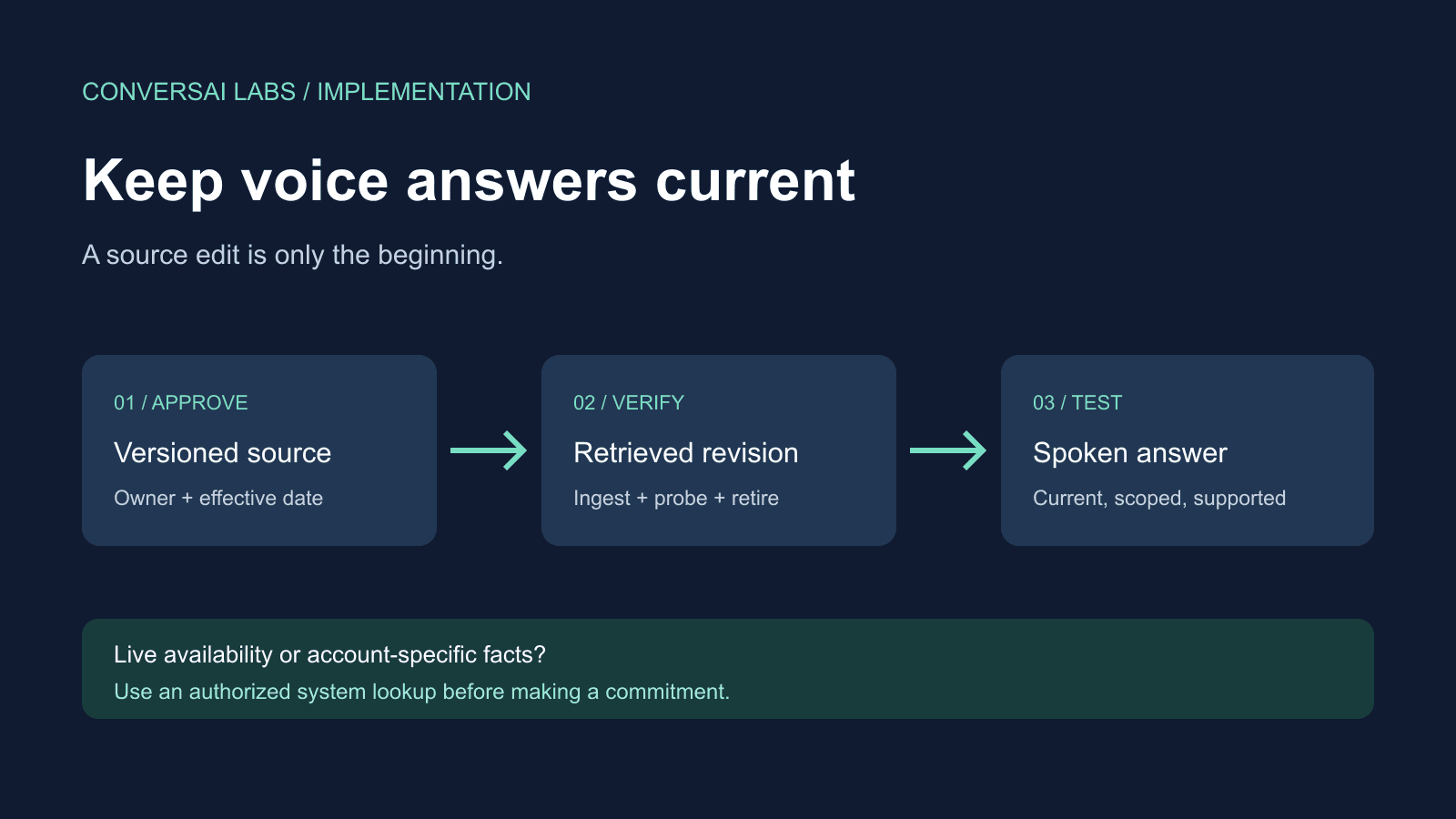
Treat a knowledge-base change as a release: approve the source, ingest the new version, verify what retrieval returns, retire obsolete material, and test the spoken answer before using it with callers. For information that changes with each transaction—such as an appointment slot or an account balance—query the authorized system of record instead of relying on a document snapshot.
Changing a PDF or website page does not, by itself, prove that a voice agent will use the new information. The searchable copy, cached answers and the current conversation may each still contain an earlier version.
This guide is published by ConversAI Labs. It describes a proposed application design, supported by vendor documentation, not comparative testing. It does not establish native ConversAI versioned retrieval, cache invalidation or atomic knowledge-release controls.
Why can a voice agent still quote an old policy?
Separate three checks: was the approved source changed, did the retrieval system ingest it, and does the live answer use it?
For example, Amazon Bedrock documents incremental synchronization after source additions, changes and deletions. Its documentation also notes that newly ingested content can take a few minutes to become queryable with vector stores other than Amazon Aurora. A completed ingestion job is therefore one check, not the entire release test. See Amazon Bedrock synchronization documentation.
That behavior is specific to the documented service. Check your own provider's ingestion status, failed-document reporting and query visibility rather than assuming every platform works the same way.
| Layer | Evidence to check | Failure to catch |
|---|---|---|
| Approved source | Owner, revision and effective date | Draft policy accidentally treated as live |
| Searchable content | Retrieved document and revision | Old chunks still returned |
| Spoken response | Test question and supported answer | Correct retrieval followed by an unsupported promise |
| Business action | Current authorized API result | A document used as proof of live availability |
Which facts belong in documents and which need a live lookup?
Use documents for approved explanations and relatively stable procedures. Use authorized APIs for facts whose truth depends on the specific customer, transaction or current inventory.
A clinic's cancellation policy can be versioned content. Whether a particular appointment slot is still free requires a current scheduling check. Keep the booking operation separate from describing the policy; our booking verification guide covers confirming the resulting record.
| Information | Suggested source | If the source is unavailable |
|---|---|---|
| Published service description | Approved, versioned document | Offer a verified general explanation or handoff |
| Current appointment availability | Scheduling API with appropriate access | Do not promise a slot; offer a callback |
| Customer-specific balance or eligibility | Authorized account system | Do not substitute a general brochure answer |
| Policy with a future start date | Document plus effective-date rule | Keep the current policy until the new one takes effect |
These are design choices to implement and test, not guarantees made by a retrieval model.
What should a knowledge update release contain?
Give each approved fact set a release identifier and a named owner. Record the source revision, approval time, effective period, applicable product or region, and retrieval verification result. Keep credentials and customer records out of this release manifest.
Consider a fictional appointment policy changing from a 24-hour cancellation window to 12 hours next Monday. Prepare the new revision in advance, but do not serve it as the current policy before its effective time. Test the old and new dates explicitly. This example is illustrative, not a ConversAI customer result.
A practical release sequence is:
- Approve: resolve contradictory documents and confirm which scope and effective date apply.
- Prepare: ingest the candidate revision into an isolated collection or otherwise keep it out of live retrieval.
- Probe: ask representative questions and inspect retrieved revisions, including requests that should return no answer.
- Activate: make the verified release eligible for live answers and expire application caches tied to the previous revision.
- Check: repeat the probes through the actual agent path, including a spoken call when appropriate.
- Retain evidence: save release identifiers and test outcomes so the team can trace and reverse a bad rollout.
If your platform cannot isolate versions or switch them together, document that limitation. Use a controlled update window or temporarily route affected questions to a human rather than describing the process as atomic.
How do you remove retired documents and stale answers?
Test removal as deliberately as addition. A replacement page can coexist with old PDFs, duplicated FAQ entries or cached summaries.
Microsoft documents that Azure Storage indexers detect content changes using timestamps, while deletion detection needs a configured strategy; deleting the source object alone can leave an orphaned search document. Its deletion documentation includes requirements and limitations that depend on the indexing setup. See Azure AI Search change and deletion detection.
For your implementation, verify that retired content is no longer eligible for retrieval. Check every representation you control: source copies, generated chunks, cached answers and prior conversation context. A source deletion and a cache purge are different operations.
During an active call, keep a consistent content release where appropriate, but always recheck transaction-specific facts before a commitment. For an urgent correction, block the affected answer and explain that it needs verification. A rollback must not restore a revoked or invalid policy merely because the previous index is available.
What should you test before and after an update?
Use the same questions on both sides of the release and record expected evidence. Do not score only whether the response sounds fluent.
| Test | Expected result |
|---|---|
| Ask the old policy question after the effective date | Current approved revision supports the answer |
| Ask before the future policy becomes effective | Existing policy remains applicable |
| Ask about another region or product | Correct scope or an explicit inability to verify |
| Ask for a withdrawn offer | Retired material is not used to promise it |
| Simulate partial ingestion or conflicting sources | Affected answer is withheld or escalated |
| Repeat a question from an already-open call | Old context does not silently override the correction |
| Restore a prior release | Only still-valid material becomes eligible |
Track the time from source approval to verified retrieval, failed-document counts, stale-answer test failures and unresolved conflicts. These measurements help locate a process failure; they are not a promise of answer accuracy. Add the cases to your voice AI regression suite.
How can you start with one voice workflow?
Pick one frequently asked question, one approved source and one owner. Prove that an update and a withdrawal both reach the actual answer path before expanding to a larger library.
For ConversAI Labs, start with the API documentation and workflow documentation, then create an account, create an agent and make a controlled test call. Confirm the knowledge-source controls available in your account; this guide does not imply those release controls are built in.
Current pricing is ₹1 per credit and four credits per connected voice minute, equivalent to ₹4/minute. Workflows are free for now; a test that connects a voice call uses the same call rate. There are 100 free credits, with allowance terms available in the account. See pricing.
About ConversAI Labs Team
The ConversAI Labs team writes about building and operating voice AI workflows.