
Featured Article
Implementation
How do you roll back a voice AI agent safely?
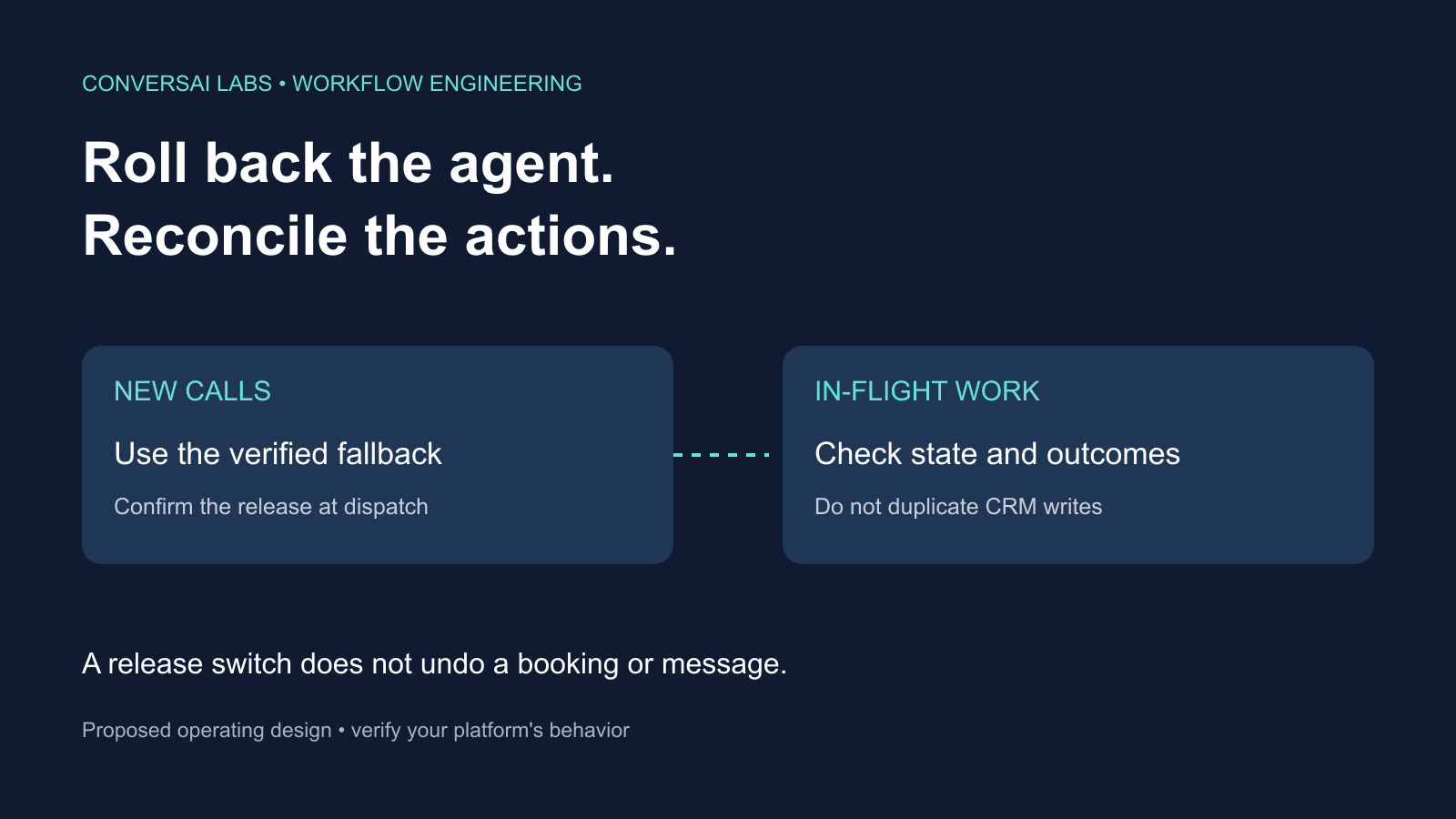
Keep a complete, versioned release of the agent and its workflow dependencies, route new calls to the last verified release, and handle active calls separately. Reverting a prompt does not reverse appointments, messages or CRM updates that have already happened. A rollback plan needs both a release switch and a way to reconcile business actions.
This guide is published by ConversAI Labs for developers and marketing operations teams. It is an engineering design based on primary-source documentation, not comparative testing or a claim that ConversAI provides every release-control feature described here.
What belongs in a voice-agent release?
Treat a release as a small manifest of the settings needed to reproduce its behavior. Saving only the prompt leaves important dependencies untracked.
| Component | What to record | Why it matters |
|---|---|---|
| Conversation | Prompt revision, model setting and language configuration | A prompt change can alter what the agent promises |
| Tools | Tool schema and adapter revision | Old arguments may not match a new CRM adapter |
| Knowledge | Approved knowledge snapshot and effective dates | A rollback must not restore an expired offer |
| Workflow | Routing rules, outcome mapping and callback policy | Correct speech can still trigger the wrong next action |
| Operations | Release ID, owner and verified fallback | An incident needs an unambiguous recovery target |
Keep secret references in the manifest, not secret values. Record the release ID against each call and asynchronous job without embedding contact details.
Version semantics differ by platform. For example, LangSmith's assistant documentation says an update creates a new version from the full configuration rather than merging a partial update. It also documents changing the active version for future runs. That is a useful example of why teams should verify their provider's exact behavior before building a release switch.
What happens to calls already in progress?
Imagine a lead-qualification agent that writes a new qualification_reason field. The new release makes inappropriate promises, so operations wants the previous agent back. A call that started before the rollback may still be waiting for its CRM response.
For a workflow you control, a practical policy is to bind the release at call start. New calls can use the fallback while existing calls finish under their original compatible configuration. Do not assume a dashboard change automatically follows this policy: test when your platform loads prompts, tools and knowledge.
If the defective behavior could harm a caller or perform an unauthorized action, continuing the call may be unsuitable. Pause new work and use a tested human handoff or controlled termination path. Operators need an explicit rule for this case, not an instruction to keep every call alive.
| Work at rollback time | Proposed handling | Evidence to retain |
|---|---|---|
| Call not started | Resolve the approved release at dispatch | Selected release and dispatch time |
| Active conversation | Keep compatible state, or invoke the incident handoff rule | Call release and recovery decision |
| Tool request awaiting response | Reconcile the original request before another write | Operation ID and destination outcome |
| Queued callback | Recheck eligibility and release compatibility before dispatch | Original intent and current approval |
| Completed CRM write | Review separately; do not assume it was undone | Destination record and any corrective action |
These are proposed operating rules, not guarantees about an individual provider.
Why can a prompt rollback still fail?
The old prompt may call a tool that has changed. A queued job may contain fields the previous adapter cannot understand. An earlier knowledge snapshot may contain information that must remain withdrawn.
AWS's rollback-safety guidance explains that old and new software can fail during transitions when they interpret shared state or protocols differently. For a voice workflow, apply that compatibility check to tool arguments, queued jobs and stored outcomes as well as deployed code.
Before release, try the fallback against state produced by the candidate. If it cannot process that state safely, choose a compatible recovery release or a controlled pause. Do not label an old commit a safe rollback solely because it once passed tests.
A practical rollback drill
- Save the candidate and fallback manifests. Confirm that revoked knowledge and permissions stay revoked in both.
- Run a synthetic call with a delayed tool response. Record the release and operation IDs.
- Switch new-call routing to the fallback. Start a second synthetic call and verify which release actually served it.
- Let the first tool response arrive. Check that it produces one authorized destination outcome, without a duplicate retry from the fallback.
- Dispatch a queued test callback. Verify its eligibility and compatible configuration before connecting it.
- Compare the call records, workflow events and destination records. Document exceptions and assign an incident owner before resuming normal volume.
Use an isolated environment and synthetic records for the drill. Our guides to sandbox testing, regression testing and call tracing cover those supporting checks.
Does rolling back undo a booking or message?
No. Changing the release used for future work does not itself cancel a booking, retract a message or reverse a CRM update. A corrective business action needs its own authorization, destination checks and audit record. If the original result is uncertain, verify it before attempting compensation.
What should an operations team ask before launch?
Ask who can pause new calls, how the active release is identified, what happens to in-flight work, and how the fallback is tested against current data. Require an observed drill result rather than a screenshot showing an older version is available.
When implementing your workflow, use the ConversAI Labs API documentation to confirm supported operations. Keep any routing, version pinning or reconciliation that the platform does not provide explicit in your own application design.
About ConversAI Labs Team
The ConversAI Labs team writes about building and operating voice AI workflows.