
Featured Article
Implementation
How do you test a voice AI workflow without changing production data?
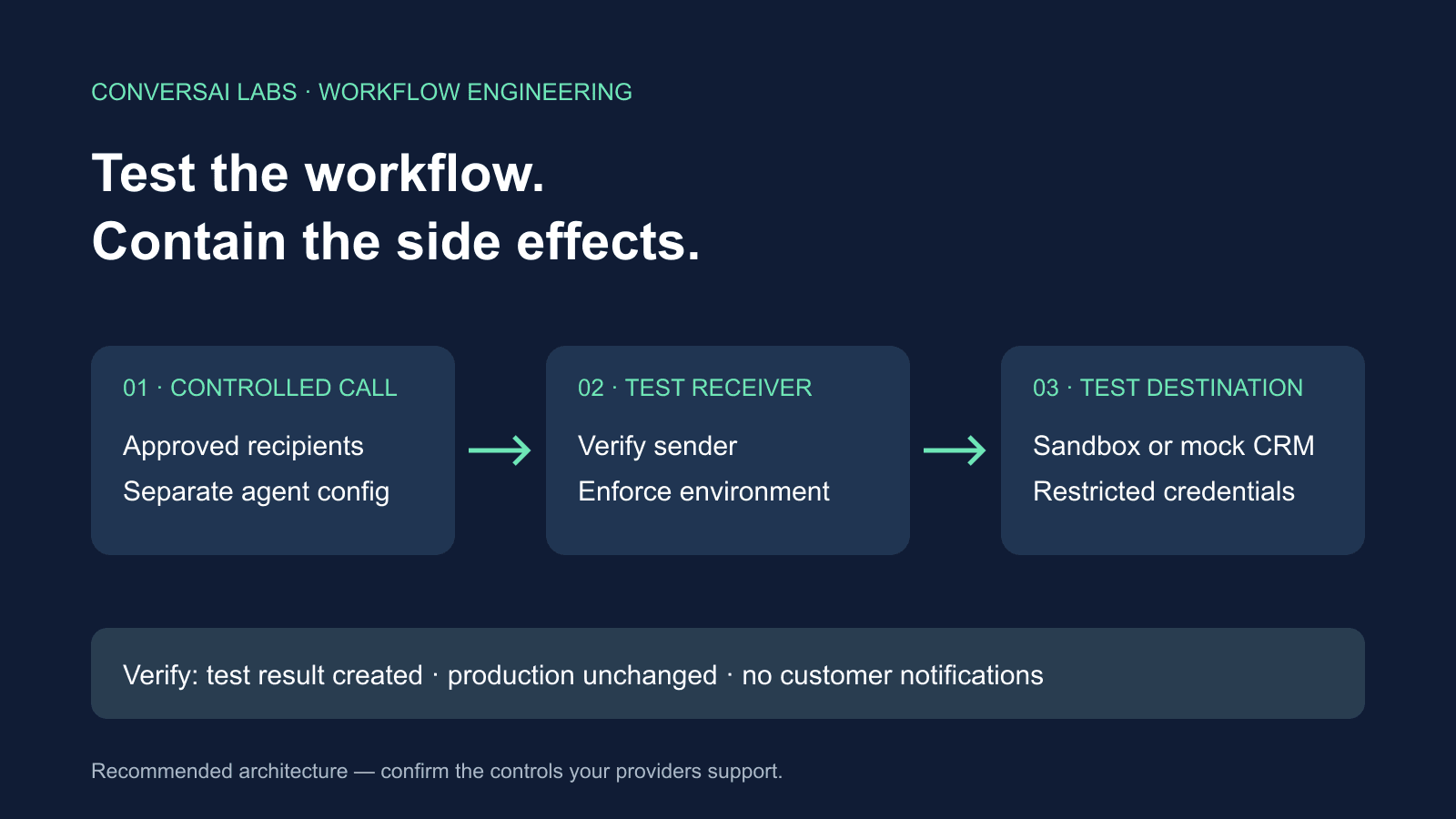
Separate the call, webhook receiver and business-system credentials used for testing. Route test events to a sandbox CRM or a mock service, restrict real calls to numbers your team controls, and verify that production records and notifications stayed unchanged. A lead named “Test” is a useful label; it does not prevent a production API key from creating a real task.
This guide is published by ConversAI Labs. The isolation pattern below is an engineering recommendation. Vendor examples come from documentation, not comparative testing, and do not establish a native ConversAI sandbox or automatic environment separation.
Why can a successful test call create real work?
Consider a marketing operations team rehearsing a qualification script. The caller uses an internal phone number, but the agent sends its result to the normal webhook endpoint. That receiver has the live CRM credential. A harmless rehearsal can now create a sales task, start an email sequence or reserve an appointment.
The risk sits in the whole chain. Changing the agent's name or adding “this is a test” to its instructions does not change the credentials, destination URLs or background jobs used after the call.
| Layer | Test configuration | Evidence to check |
|---|---|---|
| Call recipient | Explicit allowlist of controlled numbers | The requested recipient is allowed before starting a call |
| Agent and tools | Separate test configuration | Tool endpoints point to test services |
| Webhook receiver | Authenticated test endpoint | Sender and environment match the configured account |
| CRM or calendar | Sandbox account or mock with restricted credentials | Result exists only in the intended test system |
| Notifications | Test inbox or disabled delivery | No customer email, SMS or campaign enrollment occurred |
| Reporting | Explicit test classification | Synthetic runs are excluded from business conversion reports |
Treat environment selection as server configuration. Do not let caller speech or an untrusted event field choose a live credential. Authenticate incoming events before using trusted account configuration to select their destination; see our webhook security guide.
What is the difference between a simulation and a real test call?
A simulated API response can check request validation and error handling. It does not prove that a phone rings, speech is understood, interruptions work or the final business action occurs.
For example, Twilio documents that its legacy test credentials do not connect to real numbers or modify live resources. The current page also says new test credentials cannot be created in the new console; existing legacy credentials continue to work. Check what your account supports before building a test strategy around them. Twilio test-credential documentation
Use two separate stages:
- Simulated integration tests: feed synthetic results into a test receiver and verify the intended business-system changes, rejection paths and duplicate handling.
- Controlled real calls: use approved internal recipients and the isolated downstream configuration to check the actual conversation and resulting records.
A mock passing is evidence about that mock-based test. A real call connecting is evidence about connection. Neither alone proves the complete workflow.
How should the CRM and other downstream systems be isolated?
Where a provider offers a sandbox, use its sandbox credentials and resources consistently. If it does not, replace the write operation with a mock until you have a deliberately limited test account and a way to verify every side effect.
Stripe illustrates why this is a per-system decision: its documentation describes sandbox transactions that do not move funds and requires test API keys for test-card requests. That isolates the payment integration; it does not automatically isolate your CRM, calendar or notification service. Stripe testing documentation
For a lead-qualification rehearsal, create synthetic records in the test CRM, connect only the test webhook receiver, and disable outbound customer notifications there. Run the call, then inspect the resulting task and its owner. Independently inspect the live CRM for unintended changes using your authorized audit tools. Do not copy production contacts into a test account just to make the scenario realistic.
What failure cases should a test environment reject?
| Deliberate test | Expected result |
|---|---|
| A test event reaches the live receiver | Reject or quarantine it before a business write |
| The test service is configured with a live destination | Configuration check fails before the run |
| A call requests a number outside the allowlist | Call initiation is blocked |
| The same completed-call event arrives twice | Only one intended test task is created |
| A queued test job runs after a deployment | It retains its original test destination and cannot inherit live credentials |
| A test booking triggers a notification | Delivery goes only to a controlled test destination |
Keep these controls outside the language model. A prompt can describe the test; the application must enforce the boundaries. For repeated events, use the idempotency and retries guide.
How do you move from testing to a limited live pilot?
Review the exact configuration being promoted: agent instructions, tool URLs, receiver authentication, credentials, recipient policy and notification settings. Keep test queues separate so old synthetic events cannot run with newly deployed production credentials. Use an explicit operator action to start the pilot and define who can stop it.
For each pilot call, verify the destination record rather than relying on the agent's spoken confirmation. Record what was tested and what remains untested. Our regression-testing guide covers behavior checks; this article focuses on isolating the effects of those checks.
Are ConversAI Labs test calls free?
Connected test calls use the same rate as other connected voice calls: 4 credits per connected minute, equivalent to ₹4/minute; ₹1 = 1 credit. Workflow creation, runs and tests are free for now, but a workflow test that connects a voice call uses credits. There are 100 free credits; check your account for allowance terms. Do not infer tax, rounding or other billing terms from this conversion.
Start with the ConversAI Labs documentation: create an agent, generate a server-side API key, and review the read-only agent-listing request before placing a controlled test call. Confirm your webhook and downstream destinations before connecting production work. This guide does not claim that the product supplies the sandbox controls described above automatically.
About ConversAI Labs Team
The ConversAI Labs team writes about building and operating voice AI workflows.