
Featured Article
Implementation
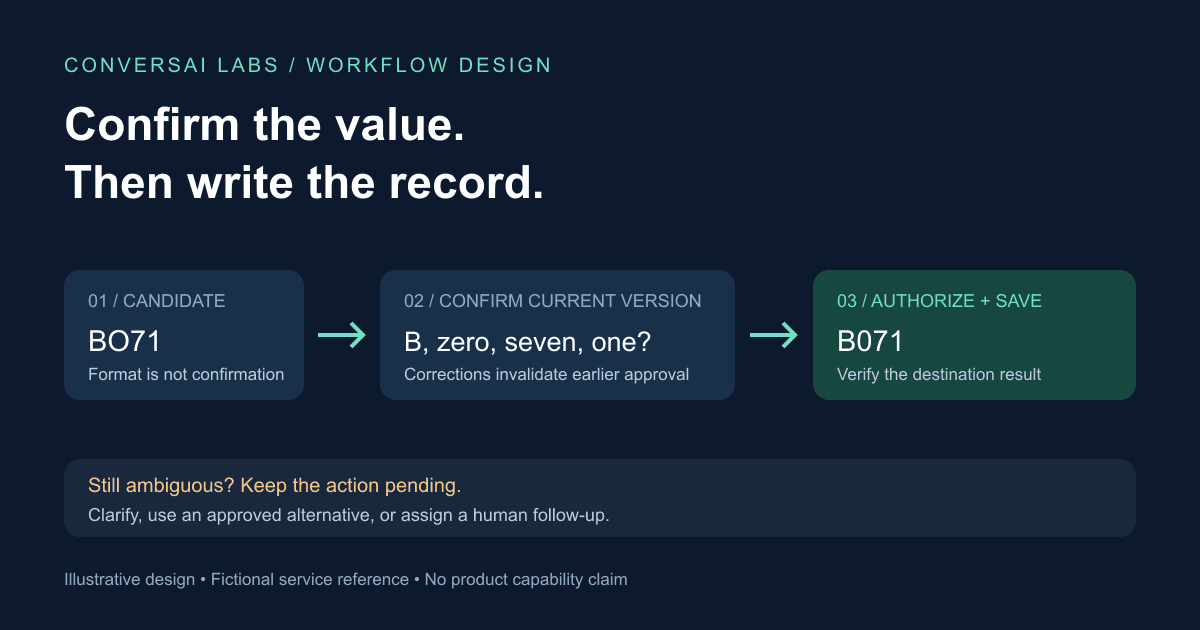
Before a voice agent saves a name, reference number or date, keep the recognized value as a candidate, check its format, and confirm the consequential details with the caller. If the caller corrects a value, invalidate the earlier confirmation. Only the latest confirmed version should be eligible for a CRM write.
A smooth conversation can still produce a wrong record. Imagine a caller giving a service reference as “B, zero, seven, one” while the transcript reads “B O 71.” Both strings look plausible. A lookup that silently chooses the nearest match may attach a follow-up to the wrong request.
This guide proposes a field-confirmation workflow for developers and marketing operations teams. It is separate from verifying that a booking or CRM write succeeded after submission.
What should a voice agent confirm before saving data?
Choose confirmation rules by the consequence of an error. A free-text preference may tolerate a short summary. A reference that selects an existing customer record deserves an exact read-back and an appropriate authorization check.
| Field | Common ambiguity to test | Suggested confirmation |
|---|---|---|
| Person or company name | Similar pronunciation; unfamiliar spelling | Ask for spelling when needed; do not force the nearest CRM match |
| Service reference | Letter O versus zero; missing leading zeros | Read characters individually and preserve the identifier as text |
| Date | Day/month order; “next Friday” | Say the full calendar date and ask the caller to confirm |
| Callback time | Morning versus evening; different local zones | Confirm date, local time and time zone together |
| Quantity | Fifteen versus fifty; units omitted | Read the quantity with its unit before an action depends on it |
Keep questions narrow. “Is everything correct?” after a long summary makes it hard to know which fields the caller accepted. “Your reference is B, digit zero, seven, one. Is that correct?” binds the answer to a specific candidate.
Confirmation is not identity verification or permission to access a record. Apply those checks separately before disclosing or modifying customer information.
Can speech hints replace caller confirmation?
No. Vocabulary hints can help a recognizer prefer relevant terms, but the resulting text still needs application checks.
Google documents model adaptation for names, domain terms and other vocabulary. Its boost setting changes recognition bias, and stronger boosts can introduce false positives. Availability also depends on the chosen language and model. Google Cloud model adaptation.
Microsoft documents phrase lists that increase the importance of supplied words or phrases at recognition time. Its examples include names, places and industry terminology. Check support for the transcription route you actually use. Microsoft phrase-list documentation.
For a pilot, use a small relevant vocabulary and compare errors with and without it. Include similar-sounding words that are not on the list. Treat a hint as recognition assistance, never as evidence that a caller selected a particular customer record.
These are vendor-documented features, not comparative testing. This article does not establish native ConversAI phrase-list controls or measured recognition accuracy.
How should corrections change the saved candidate?
Track a version for each candidate field. Bind confirmation to that version rather than keeping a single “confirmed” flag for the entire conversation.
A proposed state sequence is:
| State | Meaning | Eligible for a consequential write? |
|---|---|---|
| Candidate | Extracted from the conversation | No |
| Format checked | Satisfies the field's allowed structure | No; valid format does not prove correct content |
| Awaiting confirmation | Read-back asks about this exact version | No |
| Confirmed | Caller accepted the current version | Only after authorization and other business checks |
| Superseded | Caller corrected or replaced the value | No |
For the fictional service reference, start with candidate BO71, version 1. If the caller says “zero, not O,” replace it with B071, version 2. Version 1's pending confirmation must no longer authorize a write. Read back version 2.
If the caller says “yes, but change the last digit,” treat that as a correction, not unconditional approval. If the call ends during the read-back, leave the field unconfirmed. A delayed transcript update should not overwrite a newer confirmed value without reopening the decision.
Store identifiers as text where leading zeros matter. Validate against the actual reference format; do not invent a universal format from one example. Preserve the minimum structured audit evidence needed to explain a change, with access and retention rules appropriate to that data. Do not copy personal field values into general acquisition analytics.
What if the caller cannot confirm the value?
Give the workflow an explicit unresolved outcome. Ask a focused clarification, offer an approved alternative input route, or assign a human follow-up. Set a retry limit appropriate to the workflow so the agent does not repeat the same failing question indefinitely.
Do not fill required fields with guesses merely to pass a CRM validation rule. Keep the business action pending and show the operator which field remains unresolved. If there are several authorized lookup matches, ask for a permitted distinguishing detail instead of silently selecting the first result.
After a confirmed value is submitted, check the destination result separately. Caller confirmation does not establish that the CRM accepted a write. Our booking verification guide covers uncertain destination outcomes; the CRM conflict guide covers a human changing the record during a call.
How should teams test spoken data capture?
Create fictional test cases with known expected values. Include the languages, pronunciation patterns and call conditions relevant to the intended users, and check the saved structured result rather than judging the transcript alone.
| Test | Expected behavior |
|---|---|
| Reference starts with zero | Leading zero survives normalization and storage |
| Similar names produce two matches | No automatic merge or disclosure based on the name alone |
| Caller corrects a confirmed digit | Old confirmation invalidated; new version confirmed |
| Caller says “yes, but…” | Correction resolved before submission |
| Caller disconnects during read-back | Value remains unconfirmed; action stays pending |
| CRM rejects the confirmed value | Failure recorded; agent does not claim it was saved |
Track field-level exact matches, incorrect values accepted, clarification attempts and unresolved fields against a reviewed test set. Report the denominator and field type. A combined “accuracy” number can hide reference-number failures behind easier fields.
For callback dates, add the edge cases in our time-zone scheduling guide. For a caller correcting the agent while it speaks, test the interruption workflow as well.
Where should a ConversAI Labs pilot start?
Start with one workflow and a short list of fields whose errors matter. Define each field's format, confirmation wording, correction behavior and unresolved outcome before enabling automatic writes. Review the setup documentation and API reference, then test the complete path from a spoken correction to the destination record.
For planning connected test calls, ConversAI Labs uses ₹1 = 1 credit and 4 credits per connected voice minute, equivalent to ₹4/minute. Workflows are free for now; a test that connects a voice call consumes call credits. There are 100 free credits, with allowance terms to check in your account. See pricing before estimating usage.
The acceptance condition is concrete: the current confirmed value reaches the authorized destination, or the workflow clearly records why it did not.
About ConversAI Labs Team
The ConversAI Labs team writes about building and operating voice AI workflows.