
Featured Article
Implementation
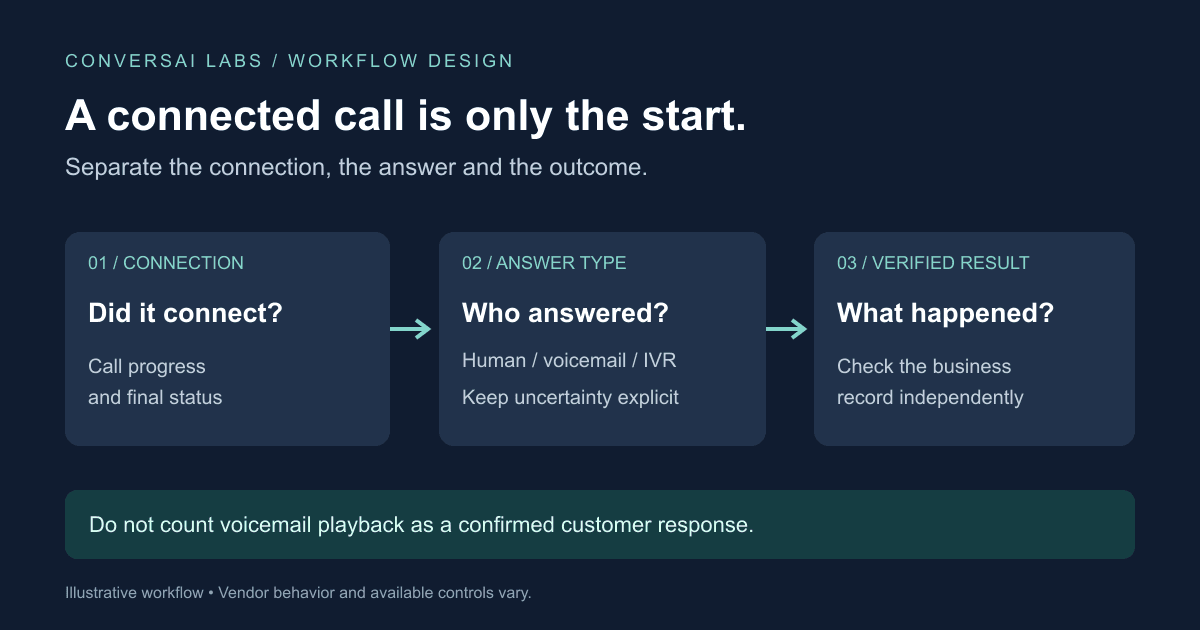
A connected voice AI call does not prove that a person answered. Record the call's transport status, the answer classification and the business outcome separately. Give voicemail, automated menus and uncertain detections their own paths before updating a lead as contacted or scheduling another attempt.
This guide is published by ConversAI Labs for developers and marketing operations teams. Vendor behavior below comes from documentation reviewed on 12 October 2026, not comparative testing. The workflow and test cases are proposed designs, not claims that every platform implements them automatically.
Does a completed call mean someone spoke to the agent?
No. Twilio documents that a completed call can involve a person, an IVR menu or voicemail. Its call-progress callback named completed can also report different terminal statuses, so inspect the payload's status instead of treating the callback name as an outcome. See the Twilio Call resource.
For a lead qualification workflow, keep three separate questions:
| Question | Example field | What it establishes |
|---|---|---|
| Did the call connect and end? | transport_status |
Telephony progress |
| What appears to have answered? | answer_classification |
Human, voicemail, IVR or uncertain classification |
| Did the requested business action happen? | verified_outcome |
A separately checked appointment, callback request or other result |
These field names describe an application data model; they are not a ConversAI API schema. A human classification alone should not qualify a lead. A greeting alone should not confirm an appointment.
How does answering machine detection affect the call?
Twilio's answering machine detection can return a human, machine, fax or unknown classification. Its synchronous mode waits for detection before continuing; asynchronous mode lets the call proceed while the decision arrives later. A message-end mode can wait for the voicemail greeting to finish. Twilio also documents that detection can be wrong, and a detection timeout can produce an unknown result. See its answering machine detection guide.
Retell documents separate voicemail and IVR handling, with choices to disconnect or leave a voicemail message. Its documented detection window is the first three minutes after connection; voicemail reached later, for example after a transfer, may therefore fall outside that window. These are Retell-specific behaviors, not universal platform limits. See Retell's voicemail and IVR documentation.
Choose settings around the actual caller experience. Measure whether a person hears an awkward delay, whether the agent speaks over a greeting, and whether the intended message starts at the right point. Do not assume a more aggressive detector is always a better one.
What should happen for each answer type?
Start with a small decision table that the operations team can review. The table below is a suggested policy; adapt it to the campaign's purpose and permitted contact rules.
| Observed result | Suggested next action | Avoid recording |
|---|---|---|
| Human classification plus an actual exchange | Continue the requested conversation and verify its result | “Qualified” from pickup alone |
| Voicemail classification | End the call or play an approved, minimal message | “Customer informed” merely because playback started |
| IVR classification | End or enter an explicitly supported navigation path | A menu response as customer intent |
| Unknown or conflicting signals | Use a bounded clarification or end and queue review | Unknown automatically mapped to human |
| Busy, no answer or failed connection | Apply the campaign's bounded retry policy | Unlimited immediate redial |
Keep the original provider classification alongside your normalized category. An absent classification should remain missing, rather than becoming a confident human answer through a default value.
If a detection result arrives after the call ended, update the record without starting another live action. Correlate it using the call identifier and check the call's current state. Handle repeated deliveries using your webhook idempotency policy.
How should a CRM record voicemail and follow-up?
Consider a fictional service-reminder workflow. A call connects, plays an approved callback message to voicemail and ends. The CRM should record the attempted contact and its voicemail classification. It should not mark the customer as having confirmed the service appointment.
Use distinct states such as message playback requested, playback completed when supported by a reliable event, and customer response received. Even playback completion does not prove that the recipient listened to the message.
Assign any next action to a named queue or role, with an expiry and attempt limit. Before a retry starts, recheck whether a person has already responded or an operator has closed the task. Keep current contact preferences and campaign eligibility in that decision. The callback scheduling guide covers time-zone handling; the CRM conflict guide covers protecting newer human edits.
What should you test before an outbound campaign?
Use synthetic greetings and controlled test numbers. These are acceptance cases, not an accuracy benchmark:
| Test case | Evidence to inspect |
|---|---|
| Short voicemail greeting | It is not silently counted as a successful human conversation |
| Person pauses before speaking | Misclassification is visible and recoverable |
| Long greeting or no clear beep | The workflow has a time limit and an explicit uncertain outcome |
| IVR menu | The menu follows its own configured path |
| Language switch or background noise | The expected languages are tested with real audio |
| Late or duplicate detection callback | No duplicate message, CRM task or redial occurs |
| Human answers, then transfers to voicemail | Behavior outside the detector's active window is understood |
Retell documents playing recorded greetings into a web call for testing, but notes that this does not reach an actual voicemail inbox. Add controlled phone calls to verify timing and message delivery on the real route. A browser-only test cannot establish what arrived in an inbox. Source: Retell testing guidance.
Track connection rate, answer classifications, uncertain results and verified workflow outcomes separately. Audit a permitted sample against the expected answer type rather than calculating detection accuracy from the detector's own labels.
Where should a small team start?
Take one outbound workflow and document its human, voicemail, IVR and uncertain branches. Test those branches before increasing call volume. Review the current API documentation and confirm which classification fields and controls your chosen calling setup actually exposes; this guide does not establish native ConversAI voicemail controls.
For ConversAI Labs, the current rate is ₹1 per credit and 4 credits per connected voice minute (₹4/minute). Workflows are free for now; a workflow test that connects a call still uses voice credits. Accounts include 100 free credits, with allowance terms checked in the account. Keep usage costs separate from verified customer outcomes. See pricing and the workflow setup guide.
About ConversAI Labs Team
The ConversAI Labs team writes about building and operating voice AI workflows.