
Featured Article
Compliance
Can voice AI safely handle PCI data? An ordinary voice AI conversation should not be treated as a card-payment channel. A safer design keeps card numbers and security codes out of the agent, its transcription service, prompts, recordings and logs, and hands payment entry to a separate payment provider. Whether your complete setup meets PCI DSS depends on its actual data flows, controls and assessment.
Updated 19 September 2026. This guide describes an architecture to evaluate; it does not establish PCI DSS validation for ConversAI Labs or provide a ready-made payment integration.
Where should the payment boundary sit?
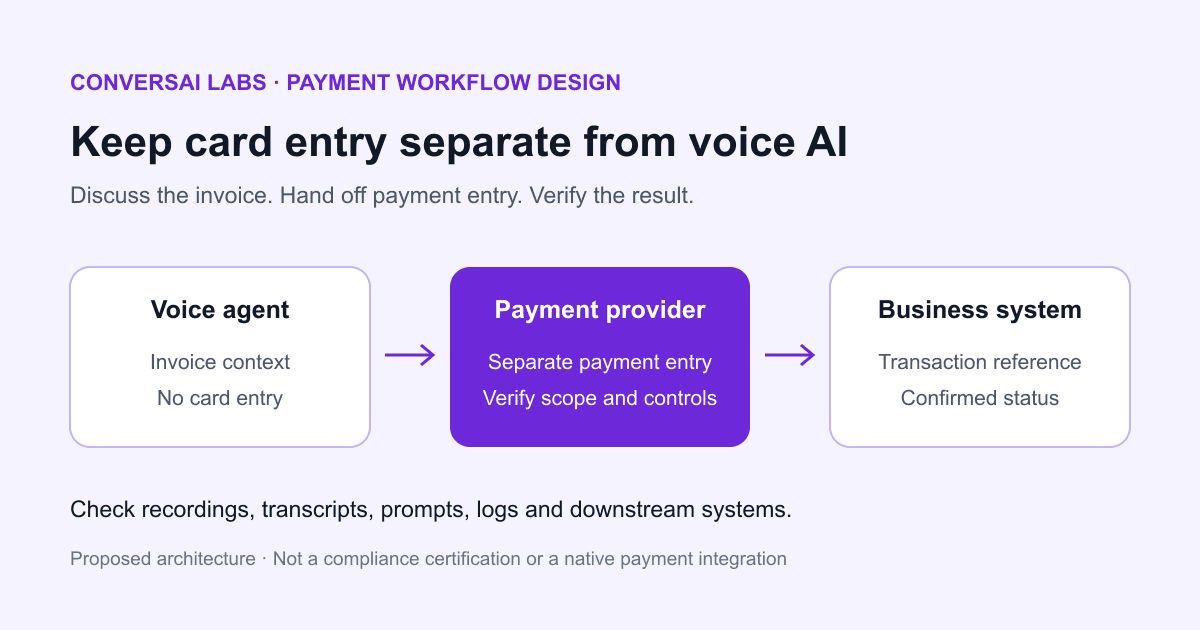
Let the agent discuss an order, explain an invoice or arrange a payment reminder. For payment entry, use a provider-hosted page or a separately assessed telephone payment flow. Return only the transaction reference and verified payment status needed by the business workflow.
Suggested flow: invoice discussion → separate payment entry → provider confirms status → business system updates invoice → agent or team follows up.
This is a proposed design, not proof that a hosted page removes every PCI obligation. The PCI Security Standards Council explains that outsourcing all payment processing does not eliminate a merchant’s responsibilities. Confirm the provider’s coverage, the division of responsibilities and your required validation with your acquirer or qualified assessor.
Can a call recording contain a CVV?
PCI DSS prohibits retaining sensitive authentication data, including card verification codes, after authorization, even if encrypted. This applies to digital audio recordings. PCI SSC’s FAQ on audio recordings and card verification codes explains the requirement and calls for preventing their recording where possible.
For a voice AI implementation, inspect more than the recording file. Map every place speech or text can travel: real-time transcription, model input, observability tools, webhook bodies, CRM notes and backups. Removing a value from the final transcript does not establish that it never reached those other systems.
Does pausing a recording solve the problem?
Pausing one recorder is not evidence that the speech recognizer, model or another connected system stopped receiving the audio. For the proposed design above, verify that payment-entry audio and digits stay outside the ordinary AI path. If you cannot demonstrate that separation, use an independently accessed hosted payment page instead of asking the caller to speak card details.
If a caller starts reading a card number unexpectedly, the agent should ask them to stop and use the approved payment route. A prompt is only one control; test the technical boundary and have a documented incident-handling process.
What about DTMF masking and tokenization?
DTMF masking can separate keypad payment entry from parts of a telephone environment, but the scope depends on the implementation. The PCI SSC’s telephone payment guidance discusses these architectures and their scoping considerations. This 2018 supplement is background guidance, not a replacement for the current PCI DSS standard.
In your design review, ask the payment provider exactly which components receive the digits and what its returned reference represents. Do not assume that a value described as a “token” automatically makes every connected system out of scope.
What should you verify before launch?
- Draw the full data flow. Include the telephony provider, recorder, transcription service, model, integration server, payment provider and destination CRM.
- Confirm the provider’s assessed service. Check that the documentation covers the particular payment product and responsibilities you intend to use.
- Inspect non-production evidence. Use your provider’s approved test data, then inspect recordings, transcripts, application logs and downstream records for unintended capture.
- Trust confirmed payment status. A caller saying “I paid” is not a verified transaction. Check the payment provider’s authoritative result before updating an invoice.
- Test interruption and recovery. Cover abandoned payments, duplicate notifications, unavailable providers and unexpected spoken card details.
- Assign an owner. Decide who investigates failures, reviews access and confirms the ongoing validation requirements.
Where does ConversAI Labs fit?
Start with a workflow around the payment: reminders, invoice questions or arranging human follow-up. Review the API and webhook documentation for the supported voice operations. Payment-provider integration and assessment are separate implementation work; do not enter live card details into an ordinary agent as a test.
For call budgeting, ConversAI Labs pricing is ₹1 per credit and 4 credits per connected voice minute (₹4/min); workflows are free for now. That usage price does not establish payment-processing capability or compliance. Discuss your proposed data flow before choosing a payment architecture.
About ConversAI Labs Team
ConversAI Labs specializes in AI voice agents for customer-facing businesses.